Search This Blog

Monday, November 1, 2010

Shade-loving shrubs

I am trying to choose the best shrub to be the centerpiece of my flower bed #3.... the one that is almost entirely under the shade of the big oak tree....

http://www.gardeningknowhow.com/trees-shrubs/shade-loving-shrubs.htm

"Carolina allspice is another shade-loving shrub that not only adds interest with its reddish-purple flowers, but this shrub also emits a pleasant spicy aroma. Prefers partial to full sun.
Downsides: comments say it spreads like crazy, and it can grow up to 25' high, I can't have that in the yard of my size...


Also worthy in the shade garden is the fragrant honeysuckle shrub (Жимолость). While you may find numerous varieties to choose from, the climbing variety will add height when trained on a trellis or similar structure. Even if you opt for the more shrubby variety, this shade lover should be placed close by, where its fragrance can be better appreciated.


Notes: http://davesgarden.com/ says that it needs full sun.


If fragrance is what you’re after than gardenias are definitely for you, provided that you reside in a warmer climate that is. Gardenias thrive in light shade and moist soil. They are evergreen, which will provide year-round interest, but it’s their intensely fragrant, white flowers that really steal the show.

Notes: I surely love the look of this plant, and it is evergreen, but I don't think it will work for Texas, unless I plant it into a container and try to water it more frequently than the rest of the garden.


Viburnum shrubs not only provide attractive, fragrant blooms but are also tolerant of shade. These sweet-smelling, shade-loving shrubs can make excellent understory plantings as well.

Notes: Dave's Garden says is can grow in partial shade, while mine is almost a full shade... And it is a little bushier than I would like, my flower bed is not that large... 


A rather large shrub but highly fragrant and exceptional for shade, is the Witch hazel. This shade lover produces lovely yellow flowers in spring.

Notes: it blooms after the first frost, and makes a nice presentation. I am thinking about having it for my flower bed #2. Dave's Garden said it likes sun to partial shade. That is closer to the conditions on my flower bed #2. 


Goat’s beard is an easy-growing shrub and makes a wonderful choice for areas of the garden with partial shade. These shrubs are especially suited to woodland gardens, opening up dark areas with their white blooms."

Notes: I don't care much for the look of this shrub, and it is a bit too bushy for my flower bed, so I think this one I can scratch out.


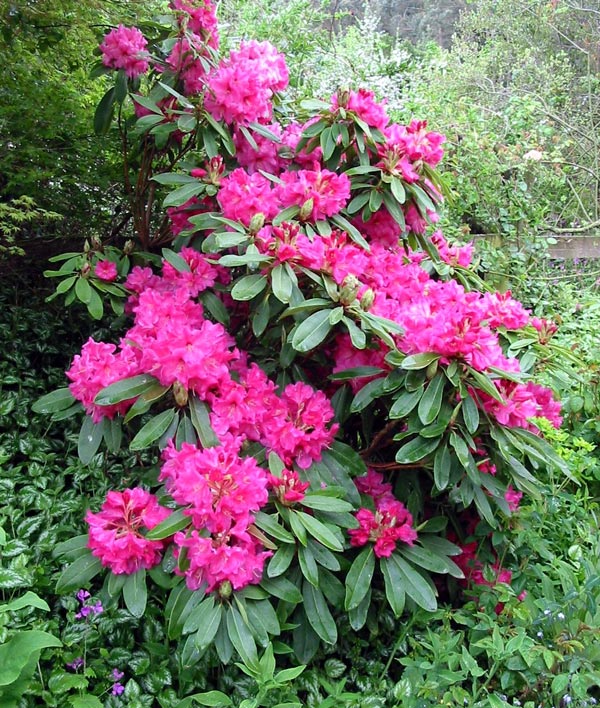
Rhododendrons and azaleas are probably some of the most popular and best loved of the shade shrubs. They not only thrive in shade but also seem to harmonize with it. These shade-loving shrubs are loved for their colorful blooms and interesting, evergreen foliage. They can be used as hedges, foundation plantings, or alone as specimen plants.

Notes: Rhododendrons are apparently poisonous for pets and humans, so although I really like the look of this plant, I don't think it would be safe to have in the yard... Apparently, same for azaleas... too bad.


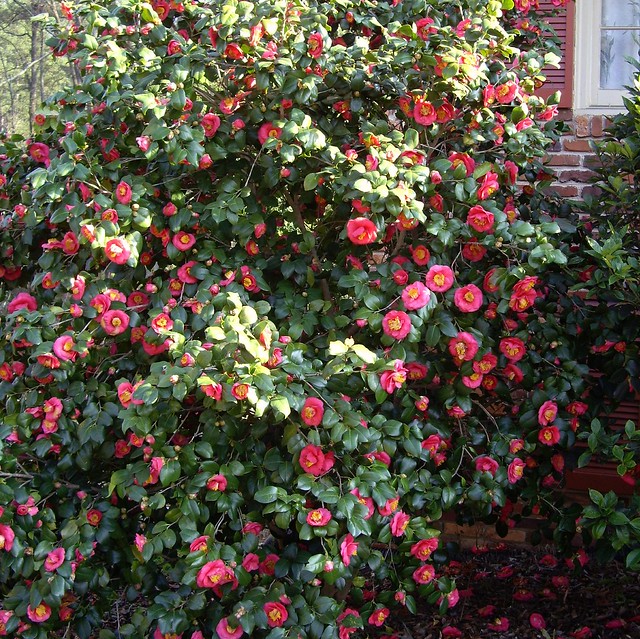
One of the finest choices for shady sites is the camellia. These evergreen shade lovers bloom in later winter or early spring in shades of red, pink, white, or bicolor."

Notes: Requires consistently moist soil - not possible in my yard. I wonder if I could plant it in a very large container, along with gardenias... 


Fragrant Orange Tea Olive


Click for a larger view of Fragrant Orange Tea Olive...


 A unique variety of osmanthus that produces an abundance of fragrant, bright orange flowers in Fall. Forms a large evergreen shrub or small tree. In the fall, one shrub will fill the backyard with a powerful and exquisite scent of perfume. Can grow to 20' tall however is usually seen at 8 to 12' in landscapes. Plant near windows and outdoor living areas where the fragrance can be enjoyed. Easy to grow in most any well-drained soil, in sun to partial shade.

Notes:  Evergreen; Average Water Needs; Acidic soil, Blooms several times a year; blooms in the winter;
I think I will have two of those planted on the flower bed #2 to form a hedge.... 

Loropetalum 'Purple Diamond'


Purple Diamond' Loropetalum boasts some of the most intense purple foliage color of any plant on the market. Vibrant pink, witchhazel-like, fringy blooms are heavy in Spring, appear occasionally in Summer and again in Fall, providing a stunning contrast with the purple foliage. An easy to grow, low maintenance shrub useful as a hedge, accent, in small groups, or in mass in landscape beds and foundation plantings. 


Nandina 'Firepower'


Nandina 'Firepower' features brilliant, fire-red foliage during Winter. A dwarf, compact selection with a globose form to 3' tall and 2 to 2.5' wide. This nandina must have well-drained soils and is best planted in raised beds. Useful in foundation plantings or landscape beds as a border, under low windows, in small groups or mass plantings, or as an accent. Low maintenance and easy to grow so long as the soil is very well-drained. Nandinas do not like wet feet! Best color in full to mostly sun, however tolerates a good deal of shade. 
Shade-loving perannials and flowers


Found a great collection of info (with pictures) on shade-loving plans:

http://wilsonbrosnursery.com/Plants/Plant-Files/Perennial-Plants/Perennial-Plants-For-Shade.aspx 

Caramel Heuchera

"A vigorous, clump-forming perennial that features unique and outstanding apricot foliage. Tiny, light pink flowers appear in spires in early summer on slender stems rising above the foliage mound."  Good for hanging baskets, containers, near a pond.


Autumn Fern

"Has spectacular foliage color that lasts all season long! New fronds unfurl as a pinkish-copper color and then mature to rich green. This 18-24" evergreen perennial fern is perfect for adding color and texture in shady areas of the garden. Also grows well in containers. " Good for hanging baskets, containers, near a pond.


Cast Iron Plant


 "Will grow in almost total shade: under decks and the canopies of large trees. The wide, lance shaped evergreen leaves are dark green, shiny and leathery and provide a vertical accent in the garden. The plants spread in clumps, but at a moderate enough rate not to be invasive or even troublesome. Does not like wet feet. Useful in containers and the garden."


East Indian Holly Fern

"An evergreen fern with dark green leaves and bright yellow variegation down the midrib. The fronds form an 18" by 18" attractive clump in the garden. This fern prefers growing in shady areas of the garden in humus-rich, moist but well-drained soil. Also suitable for growing in containers. "


Helleborus 'Royal Heritage' - Lenton Rose


"Blooms for up to 5 months and is widely adaptable from north to south. Very resistant to deer, rabbit, and voles! Purple, red, pink, white, yellow, green and black flowers are produced from late Winter through mid-Spring, and when cut and floated will last for two weeks. Highly resistant to disease and pests, and very tolerant of heat, humidity and drought. Long-lived." (NO SCENT)


Halcyon Blue Hosta

 "Halcyon Blue Hosta Lily has heart-shaped blue-gray foliage and a compact form which makes it an excellent choice for the small garden. Best foliage color is achieved in full shade though some morning sun is tolerated well. Forms a ompact mound to 18 inches high and 3 feet wide making it excellent for use as an edging in the shade garden. Proven more resistant to slugs than others"


Japanese Painted Fern


"2004 Perennial Plant of the Year! The attractive, soft, metallic silver-grey fronds form a clump more than 24" across. A great plant to light up shady areas of the garden. Thrives best in light shade or morning sun with afternoon shade, and humus-rich, loamy soil. "


Palace Purple Heuchera


"Clump-forming perennial which features a 12" tall mound of maple-like leaves which are an attractive deep purple above and beet-red beneath. Foliage color may fade to a bronze-green in hot summers. Tiny, white, bell-shaped flowers in open, airy panicle rise avove the foliage on slender, wiry, dark red stems. At home in the shade or woodland garden. 1991 Perennial Plant of the Year."


Patriot Hosta Lily


 "One of the most exciting hostas to come along in some time. The foliage is dark green with a broad, wavy margin of pure white, creating an especially strong and highly visible contrast which literally lights up any shady area. Plants grow vigorously to 20" tall and nearly twice as wide. Lavender flowers appear on 26-30" scapes in Summer. "


Sum And Substance Hosta Lily


 "Sum and Substance Hosta Lily is a strong growing, huge hosta with large chartreuse-yellow wavy leaves. Excellent for partial sun even in southern gardens. Extremely pest resistant. Very fragrant, lavender flowers rise above the foliage on 50" scapes! A truly outstanding plant for the garden."


Silver Scrolls Heuchera


 "Silver Scrolls Heuchera is a clump-forming perennial that features large, metallic silvery-purple leaves with dark purple veining and conspicuous but non-showy whitish flowers. The foliage forms a mound to about 8" tall by 12" wide. Tiny, whitish flowers borne in open, airy panicles appear in late spring to early summer on slender, wiry stems rising well above the foliage mound. Great in the garden or containers."


Tassel Fern


"The Tassel Fern features beautiful rich, dark green fronds that have a silvery underside. It is a stunning evergreen foliage plant for shaded gardens, or at woodland's edge. New fronds continue to emerge all summer. Keep's its fronds from one year to the next, so no need to clip off the previous years growth. In the springtime the Tassel Fern puts on a burst of growth, the young fronds resembling tassels"


Columbine (Aquilegia)


" Columbine is a hardy, shade loving evergreen perennial. This is a nice alternative to perennials that die back completely in the winter because the foliage remains attractive throughout the year. Flower colors range from yellow, pink, red, blue and white and bloom early to mid spring. If the soil is well drained, they do well in poor to average soil and once established need only medium to light watering."


Lily of the Valley (Convallaria Majali)  Ландыш?


"If you would like to bring fragrance to your shade garden, look no further! In May, tiny white bells flower amidst green foliage and beckon you outside to inhale the fresh spring air. This shade loving plant is hardy and tough to get rid of once established. They thrive is loamy to clay soils. This is one plant you should seriously consider when planning your shade garden."


Bleeding Heart (Dicentra Spectabilis)

"Perennial favorite of shade garden growers. Pink heart shaped blooms appear in April or May. This gorgeous flower thrives in well drained soil with plenty of humus. The beauty of these flowers is fleeting and once their blooms fade, the foliage dies back. These shade lovers are best planted amongst Hosta, Coral Bells or Lily of the Valley that will help to fill the vacancy left in your shade garden after the Bleeding Heart fades away with the arrival of summer."


 Foxglove (Digitalis)

 "This shade lover is the source of the potent heart drug "Digitalis" and is considered to be poisonous when eaten. It is quite safe to touch. Foxglove is also a biennial, which means it will grow leaves in the first year and flower in the second year. Fortunately, they produce a large quantity of seed, so you don't need to worry about continuing to replace them. This plant blooms in early summer. Provided that is has soil rich in compost or old leaves, it will grow to 2 to 3 feet tall. The blooms range from pink to yellow or brown."


Grape hyacinth


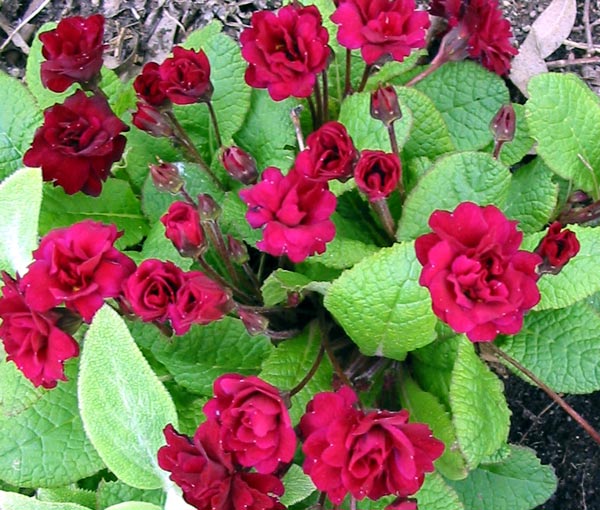
 Primroses


Gas Plant

Mertensia


Monarda


 Stachys


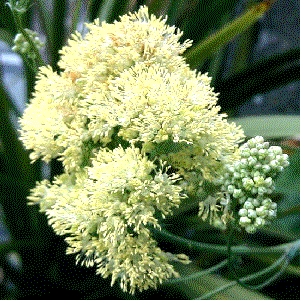
 Thalictrum 


Campanulas


Wednesday, October 27, 2010

French Lilac

After long and hard internal debate about the type of aromatic flowering shrub that I would put in my yard's only semi-sunny spot I ordered French Lilac. Partially because it is hardy and drought resistant, and partially because it would remind me of my homeland, Russia. Lilac grows next to the building where I grew up, and all around my hometown... I miss it very much.

The lilac will hopefully become an impressive bush sometime down the road, but as of right now, it is a pair of pathetic-looking twigs with 6 leaves and a few buds. It does not appear to be "growing vigorously" yet - perhaps, because it is October. I am getting worried it might die during the winter, so I decided to move it indoors. It will be my second indoor plant in ages (my first indoor plans is Aloe Vera, and I bought it just a few weeks ago). I really don't have alot of well-lit areas inside that are safe from dogs and other potential dangers, but I still think that it would be best to move it here.

The problem is - I need a tall enough and sturdy enough pot to keep the dogs away, and I think I found one, but I want the lilac to go into some kind of a container that I can pull out and replant with minimum root disturbance next Spring. So, I am on a mission to find an ecologically friendly container that  would be sturdy enough to survive 4-5 months being undergrounds and exposed to moisture and other elements, and yet hold it's shape will the time I decide to transport the plan into the ground.

Tuesday, October 19, 2010

Renee's pumpkin present

Renee and Richard decided to invite us for a dinner at their place, so I thought that bringing along a little seasonal gift would be a good gesture. So, I decided to try out my "waxed pumpkin flower pot" idea. My previous experiments showed that Vaseline did a great job at preserving the pumpkin flower pots, so I decided to try out the bee wax as an even heavier-duty preservative. I read up on the old-days canteen making with hot wax, so I had a general idea on what to do.

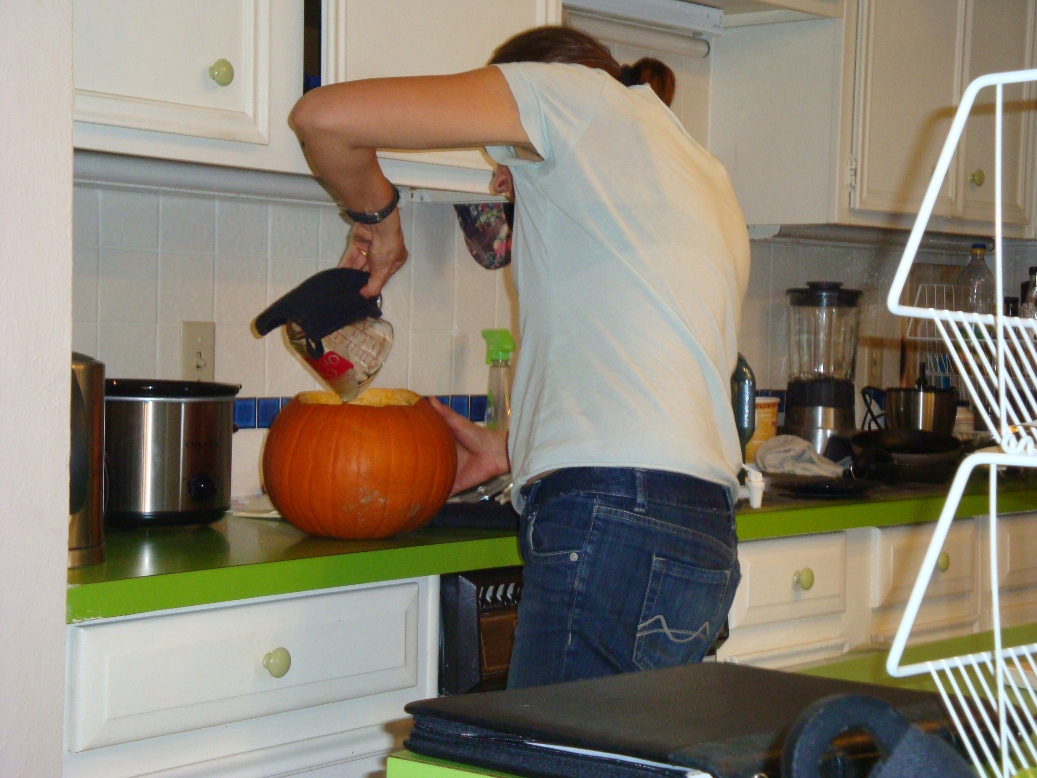
So, here we go, I got a good-size pumpkin, very carefully scrubbed (to avoid any deep cut where a mold could start to grow). I got about 5 oz of melted wax. I also decided to sprinkle some cinnamon on the walls of the pumpkin, to capture the "holiday scent" inside. As another olfactory-pleasing measure, I added a few drops of clove oil to the wax. So, let the fun begin....


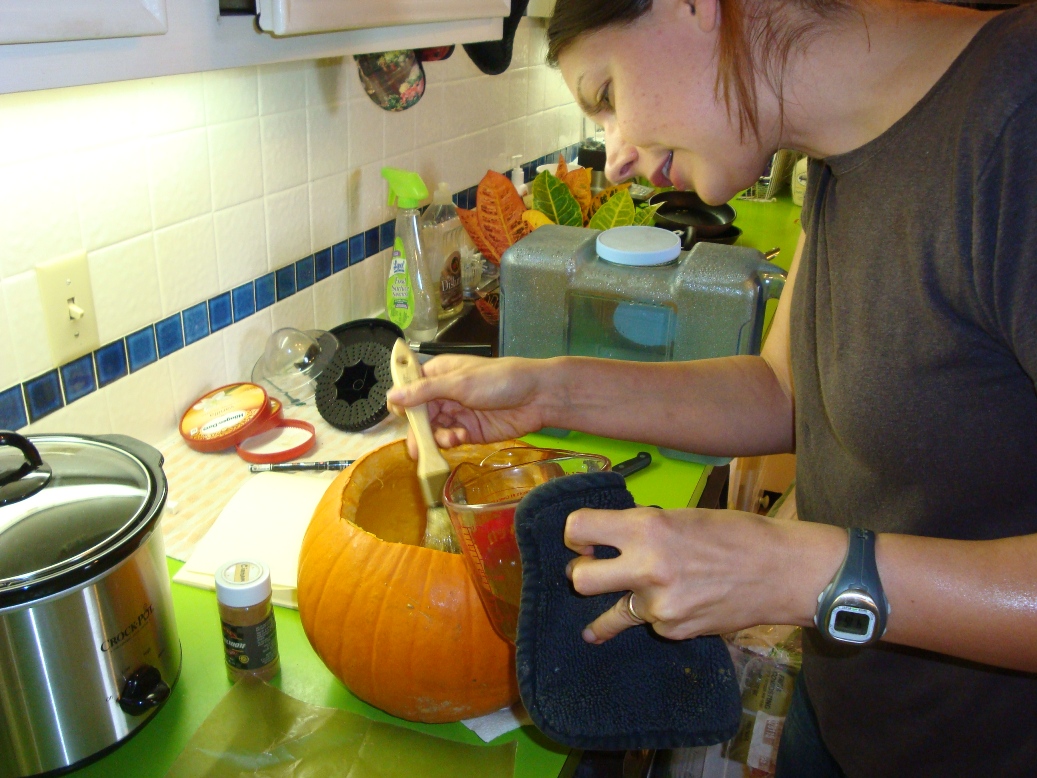
Voila! A nicely coated pumpkin - almost to the edges! I could not coat the edges. The wax was cooling down too quickly, and swooshing hot wax too close to my hands was too scary, so I decided to try a paint brush to finish up the top part. Melting more hot wax took time that I did not budget in, but hey, it was too late to be coming up with any other presents. So, I worked as fast as I could.


I went over the edges several times, to make sure that all crevices and cuts were well-coated, to retard future molding and moisture loss for as long as possible.


After the wax hardened (just barely!), I could insert the flower pot.


I thinned the leaves of the flower a bit, so they would not look too bushy. The last touch was making a maple-leaf shapes note, drawing a smiling face on the pumpkin, and making a straw broom to bring home the message that the pumpkin was actually a face. The broom-making experience was a bit of a challenge at first, but became my favorite part quickly.


Unfortunately, we were starting to run late, so in a hurry I forgot to make a picture of the final product. I will see if I could get it from Renee later.

Candle "Orange Alien"

I was wondering what would happen if I poured hot wax into a scrubbed-clean pumpkin shell. Would it smell like baked pumpkin? And what is I added some cinnamon to the wax? There was only one way to find out...

So, here we go. A baby-pumpkin candle experiment ready to start. Pumpkin is nicely cleaned out and the wick is ready to go. I decided to do two wicks, because I didn't think that one would have a chance to melt even a third of the volume of the wax.


I pre-mixed the ground cinnamon with the hot bee wax and poured it into the shell. The cinnamon made the cooling wax to appear "dirty" in color, but it smelled great.


The result was a very cute little thing that looked great on the dining table, but I made it way too shallow. The wick burned almost to the holder before the was on the edges started to warm up.


When it was burning, it looked like a glowing orange face with flickering eyelashes, very eery. It did not smell like pumpkin, though. It did not even smell too much like cinnamon. Smelled more like hot honey. 

Next time I think I will put 3 wicks in place, so the burning candle would look almost like a face :)


Меня мучил вопрос - будет ли свечка пахнуть, как пекущаяся тыква, если я залью ее горячим воском и зажгу? А так же, как будет пахнуть свечка, если я в горячий воск добавлю корицы? Как обычно, узнать ответы на эти вопросы можно было только одним способом....
Итак, малюсенький тыквенок был выбран для экспериментальной заливки. Два фитиля были приготовлены, как надо (я рещила, что раз база у свечки широкая, то один фитиль не справится). Я смешала корицу с горячим пчелиным воском (очень вкусно запахло, медом и корицей) и - вперед. Вышло очень симпатично, есди поставить в центр обеденного стола зажженной. Когда весь воск разогрелся, то было похоже на лицо солнца  - оранжевое, мерцающее, с живыми пламенными глазами. В следующий раз я решила сделать 3 фитиля, чтоб еще больше на лицо походило.

К сожалению, ни запаха тыквы, ни запаха корицы особо заметно не было, зато горячим медом пахло обалденно.


Sunday, October 17, 2010

A composter dream come true

I was not really thinking about a tumbling composter until I saw one at Home Depot. Since that moment, I was restless, because I really wanted to start putting to use all the darn leaves that my neighbors' two trees are shedding into my yard. I hate to put them in the trash, or even in the recycled bags, because I know that they could be a great (and free) nutrition for my yard. So, I was preoccupied with various composing dreams and ideas for several days before I decided to bring the subject up with my husband. Since he did not mind, I went and bought the pretty-looking black behemoth called Garden Views 60 Gal. Dynamic Spinning Composter
at Home Deport for $98. It looked awesome on the picture. I did my research - there were not alot of reviews on that item on the Net, but at least one guy reported liking it, so I decided to take a plunge. So, I brought my purchase home, glowing with anticipation.


But putting that little boy together proved to be a mission impossible for me. The barrel was made of thin interlocking plastic sections that would not snap together for me no matter how I tried. After 30 or 40 min of puffing and cussing, I finally broke one of the snapping extensions, and that was the end of it (and of my patience). I tossed all the parts back into the box and sadly headed back to Home Depot to do a return.

But the vivid dreams of a tumbling composter were still marching through in my inner vision. So, from Home Depot I drove straight to Lowes and, to my delight, they were carrying a different, seemingly more sturdy version - Suncast 49 Gal Tumbling Composter for $98. The barrel looked pre-assembled, which was a selling point for me. I took the new baby home the same day.


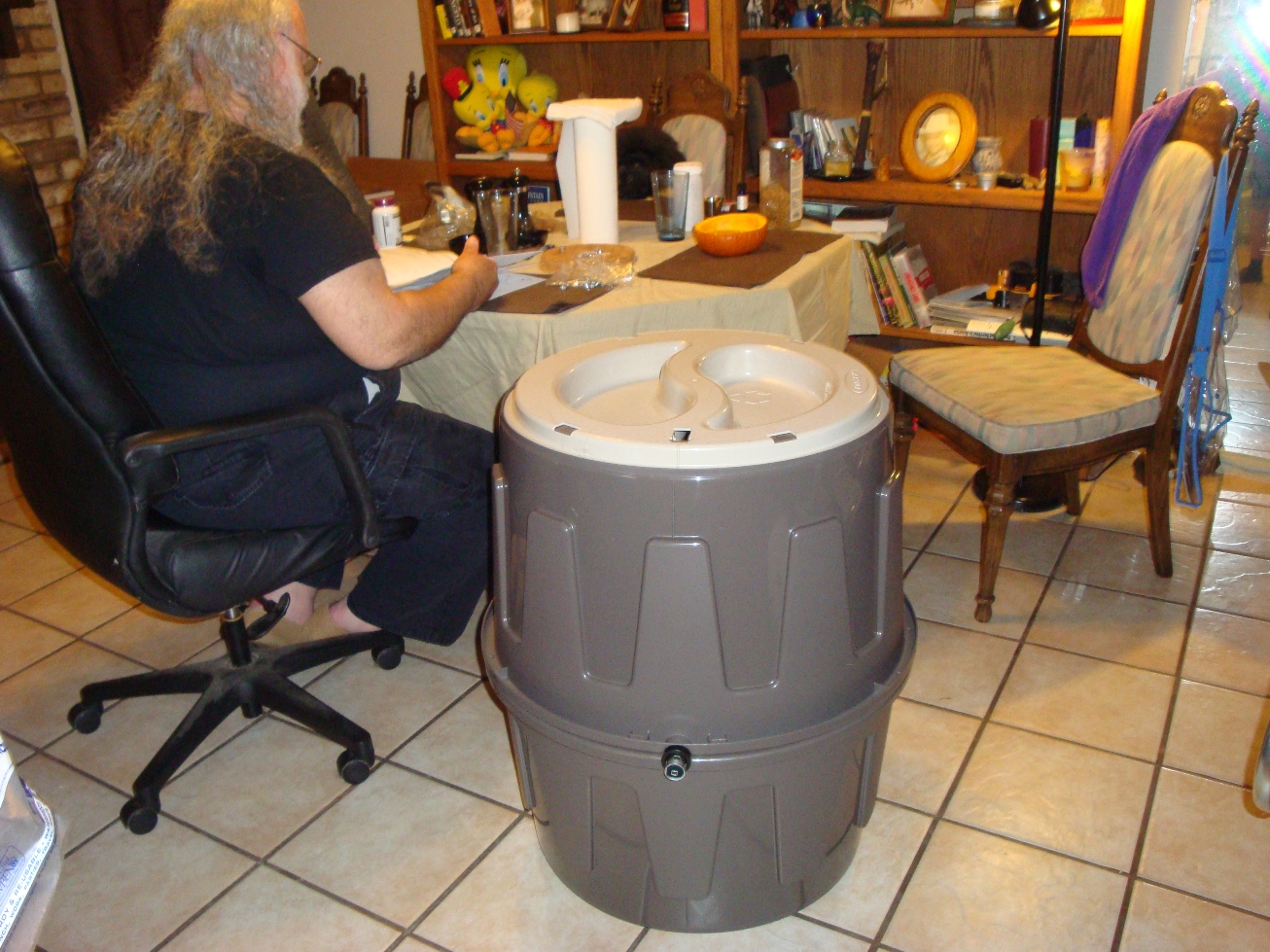
Even though the barrel came in two large pieces and required little assembly, getting the rest of the construction set up took some time and some help from my husband.

 But eventually (about an hour later), the joy of my heart was standing up and looking pretty in our dining room.

The whole thing was bigger and heavier than I would like, and I was not quiet sure where in my yard it would actually fit, but those minor consideration could not distract me from my joy - I was now a tumbling composter owner, and I was ready to start composting!

Troubling realization

Hmmm, very recently I realized  that some parts of my garden are completely in the shade of  either Particia's tree (on the west side of the yard) or the walnut tree on the east side of the yard. As a results, even though the yard is on the south side of the building, my yard is either in the partial shade or full shade pretty much at all times. Unfortunately, both the flower bed #1 and the flower bed #3 (the ones I actually plan to utilize for planing) are in the most heaving shaded areas. The flower bed #2, the one I plan to use as a doggy toilet, is the sunniest spot in the entire yard. That makes me reconsider my original yard design. Grrr....


Не так давно, одним солнечный днем, я в первый раз заметила, что большинство моего двора затенено деревьями. Я западной стороны у моих соседей растет огромный дуб (или нечто похожее), а с восточной стороны у моих вторых соседей растет ореховое дерево. В итоге, несмотря на то, что двор расположен на южной стороне дома, в любое время дня практически 80-90% дворя находятся в тени. К сожалению, мои грядки №1 и №3 (по обоим сторонам двора) находятся непосредственно под деревьями, и, поэтому, самые затененные. Грядка №2, которую я планировала сделать собавьим туалетом, получает больше всего солнца. А так же полоса земли прямо возле гаража тоже получает больше всего солнца.

Эти новые соображения вносят изменения в мои изначальный план. Хммм...